
Excercise 2.1
1. The graphs of y=p(x) are given in figure below, for some polynomial p(x). Find the number of zeroes of p(x), in case.
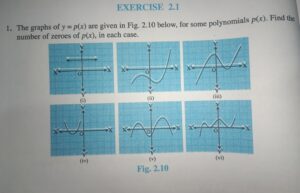
Answer:
(i) The numbers of zeroes is 0, because the graph intersects the x-axis at NO point.
(ii) The numbers of zeroes is 1, as the graph intersects the x axis at one point.
(iii) The numbers of zeroes is 3, because the graph intersects the x-axis at 3 point.
(iv) The numbers of zeroes is 2, because the graph intersects the x-axis at 2 points.
(v) The numbers of zeroes is 4, because the graph intersects the x-axis at 4 points.
(vi) The numbers of zeroes is 3, because the x-axis is intersected by the graph for 3
Excercise 2.2
1. Find the zeroes of the following quadratic polynomials and verify the relationship between the zeroes and the coefficients:
(i) \( x^2 – 2x – 8 \)
Soln: \( x^2 – 2x – 8 = 0 \)
\( \Rightarrow x^2 – (4 – 2)x – 8 = 0 \)\( \Rightarrow x^2 – 4x + 2x – 8 = 0 \)\( \Rightarrow x(x – 4) + 2(x – 4) = 0 \)\( \Rightarrow (x – 4)(x + 2) = 0 \)Therefore,
\( \begin{array}{c|c} x – 4 = 0 & x + 2 = 0 \\ x = 4 & x = -2 \end{array} \)Now,
Sum of zeroes
\( 4 + (-2) = \frac{-(-2)}{1} \)\( 2 = 2 \)Product of zeroes
\( 4 \times (-2) = \frac{-8}{1} \)\( -8 = -8 \)(ii) \( 4s^2 – 4s + 1 \)
Soln: \( 4s^2 – (2 + 2)s + 1 = 0 \)
\( \Rightarrow 4s^2 – 2s – 2s + 1 = 0 \)\( \Rightarrow 2s(2s – 1) – 1(2s – 1) = 0 \)\( \Rightarrow (2s – 1)(2s – 1) = 0 \)Therefore,
\( \begin{array}{c|c} 2s – 1 = 0 & 2s – 1 = 0 \\ s = \frac{1}{2} & s = \frac{1}{2} \end{array} \)Verify.
Now,
Sum of the zeroes \( \frac{1}{2} + \frac{1}{2} = \frac{-(-4)}{4} \)
\( \Rightarrow \frac{2}{2} = \frac{4}{4} \)\( \Rightarrow 1 = 1 \)Product of the zeroes \( \frac{1}{2} \times \frac{1}{2} = \frac{1}{4} \)
\( \frac{1}{4} = \frac{1}{4} \)(iii) \( 6x^2 – 3 – 7x \)
Soln: \( 6x^2 – 7x – 3 = 0 \)
\( \Rightarrow 6x^2 – (9 – 2)x – 3 = 0 \)\( \Rightarrow 6x^2 – 9x + 2x – 3 = 0 \)\( \Rightarrow 3x(2x – 3) + 1(2x – 3) = 0 \)\( \Rightarrow (2x – 3)(3x + 1) = 0 \)Therefore,
\( \begin{array}{c|c} 2x – 3 = 0 & 3x + 1 = 0 \\ 2x = 3 & 3x = -1 \\ x = \frac{3}{2} & x = -\frac{1}{3} \end{array} \)Now,
Sum of zeroes, \( \frac{3}{2} + \left(-\frac{1}{3}\right) = \frac{-(-7)}{6} \)
\( \frac{7}{6} = \frac{7}{6} \)Product of the zeroes \( \frac{3}{2} \times \left(-\frac{1}{3}\right) = \frac{-3}{6} \)
\( \frac{-3}{6} = \frac{-3}{6} \)(iv) \( 4u^2 + 8u \)
Soln: \( 4u(u + 2) = 0 \)
\( \begin{array}{c|c} 4u = 0 & u + 2 = 0 \\ u = 0 & u = -2 \end{array} \)Now,
Sum of the zeroes \( 0 + (-2) = \frac{-8}{4} \)
\( -2 = -2 \)Product of the zeroes \( 0 \times (-2) = \frac{0}{4} \)
\( 0 = 0 \)(v) \( t^2 – 15 \)
Soln: \( t^2 – (\sqrt{15})^2 = 0 \)
Therefore,
\( \Rightarrow (t – \sqrt{15})(t + \sqrt{15}) = 0 \)\( \begin{array}{c|c} t – \sqrt{15} = 0 & t + \sqrt{15} = 0 \\ t = \sqrt{15} & t = -\sqrt{15} \end{array} \)Now,
Sum of the zeroes
\( \sqrt{15} – \sqrt{15} = \frac{0}{1} \)\( 0 = 0 \)Product of the zeroes \( \sqrt{15} \times (-\sqrt{15}) = \frac{-15}{1} \)
\( -15 = -15 \)(vi) \( 3x^2 – x – 4 \)
Soln: \( 3x^2 – x – 4 = 0 \)
\( \Rightarrow 3x^2 – (4 – 3)x – 4 = 0 \)\( \Rightarrow 3x^2 – 4x + 3x – 4 = 0 \)\( \Rightarrow x(3x – 4) + 1(3x – 4) = 0 \)\( \Rightarrow (3x – 4)(x + 1) = 0 \)Now,
\( \begin{array}{c|c} 3x – 4 = 0 & x + 1 = 0 \\ 3x = 4 & x = -1 \\ x = \frac{4}{3} & \end{array} \)Now,
Sum of the zeroes \( \frac{4}{3} – 1 = \frac{-(-1)}{3} \)
\( \frac{1}{3} = \frac{1}{3} \)Product of the zeroes
\( \frac{4}{3} \times (-1) = \frac{-4}{3} \)\( -\frac{4}{3} = -\frac{4}{3} \)
(vii) \( x^2 + 7x + 12 \)
Soln: \( x^2 + 7x + 12 = 0 \)
\( \Rightarrow x^2 + (3 + 4)x + 12 = 0 \)\( \Rightarrow x^2 + 3x + 4x + 12 = 0 \)\( \Rightarrow x(x + 3) + 4(x + 3) = 0 \)\( \Rightarrow (x + 4)(x + 3) = 0 \)\( \begin{array}{c|c} x + 4 = 0 & x + 3 = 0 \\ x = -4 & x = -3 \end{array} \)Now,
Sum of the zeroes
\( -4 – 3 = \frac{-7}{1} \)\( \Rightarrow -7 = -7 \)Product of the zeroes \( -4 \times (-3) = \frac{12}{1} \)
\( +12 = 12 \)(viii) \( x^2 – 4x + 3 \)
Soln: \( x^2 – 4x + 3 = 0 \)
\( \Rightarrow x^2 – (3 + 1)x + 3 = 0 \)\( \Rightarrow x^2 – 3x – 1x + 3 = 0 \)\( \Rightarrow x(x – 3) – 1(x – 3) = 0 \)\( \Rightarrow (x – 3)(x – 1) = 0 \)\( \begin{array}{c|c} x – 3 = 0 & x – 1 = 0 \\ x = 3 & x = 1 \end{array} \)Now,
Sum of the zeroes
\( 3 + 1 = \frac{-(-4)}{1} \)\( \Rightarrow 4 = 4 \)Product of the zeroes \( 3 \times 1 = \frac{3}{1} \)
\( 3 = 3 \)(ix) \( x^2 – 6x – 7 \)
Soln: \( x^2 – (7 – 1)x – 7 = 0 \)
\( \Rightarrow x^2 – 7x + 1x – 7 = 0 \)\( \Rightarrow x(x – 7) + 1(x – 7) = 0 \)\( \Rightarrow (x – 7)(x + 1) = 0 \)\( \begin{array}{c|c} x – 7 = 0 & x + 1 = 0 \\ x = 7 & x = -1 \end{array} \)Now,
Sum of zeroes
\( 7 + (-1) = \frac{-(-6)}{1} \)\( \Rightarrow 6 = 6 \)Product of the zeroes
\( 7 \times (-1) = \frac{-7}{1} \)\( -7 = -7 \)(x) \( 2x^2 – 5x – 7 \)
Soln: \( 2x^2 – (7 – 2)x – 7 = 0 \)
\( \Rightarrow 2x^2 – 7x + 2x – 7 = 0 \)\( \Rightarrow x(2x – 7) + 1(2x – 7) = 0 \)\( \Rightarrow (x + 1)(2x – 7) = 0 \)\( \begin{array}{c|c} x + 1 = 0 & 2x – 7 = 0 \\ x = -1 & 2x = 7 \\ & x = \frac{7}{2} \end{array} \)Now,
Sum of the zeroes \( -1 + \frac{7}{2} = \frac{-(-5)}{2} \)
\( \frac{5}{2} = \frac{5}{2} \)Product of the zeroes \( -1 \times \frac{7}{2} = \frac{-7}{2} \)
\( -\frac{7}{2} = -\frac{7}{2} \)